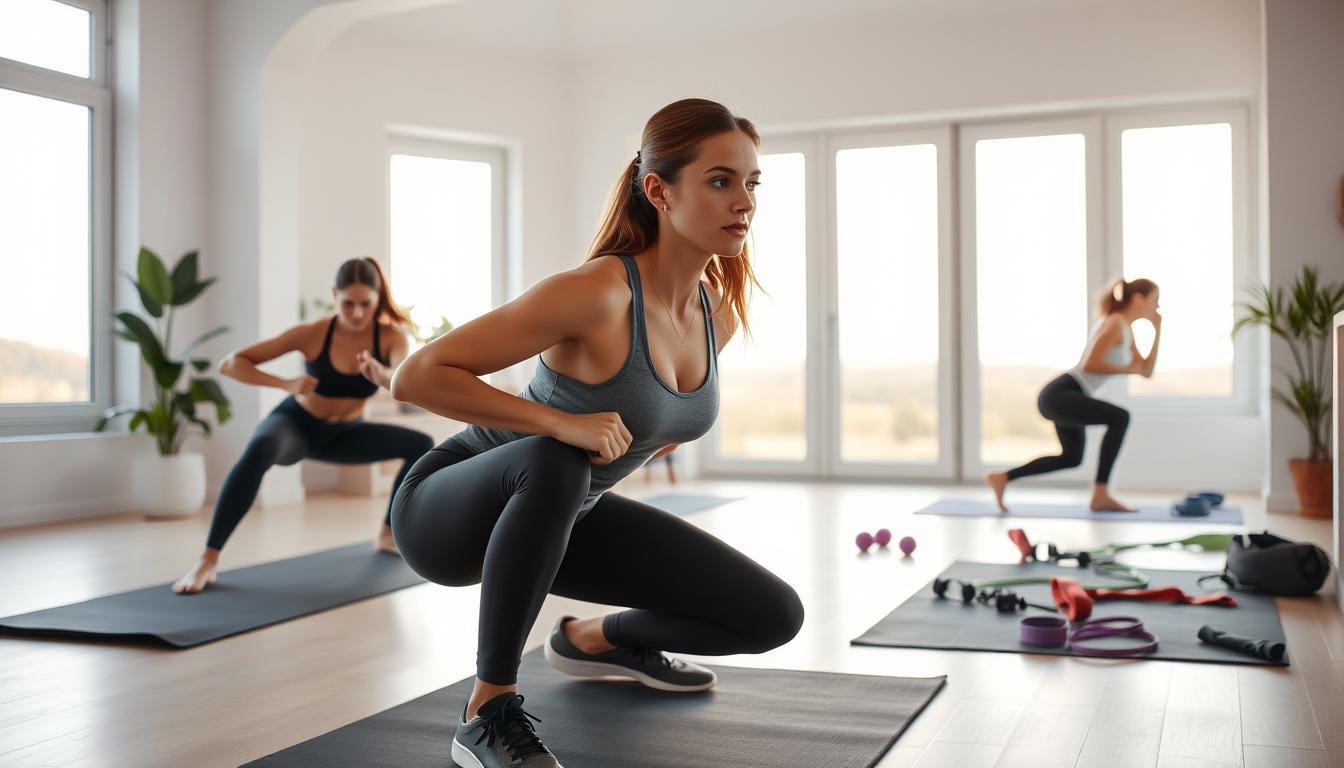
Staying fit doesn’t require a gym membership or specialized equipment. With equipment-free workouts, you can achieve your fitness goals from the comfort of your home or while traveling.
These quick fitness routines are not only convenient but also versatile, allowing you to create a varied workout regimen that suits your lifestyle. Whether you’re looking to improve cardiovascular health, strengthen muscles, or enhance flexibility, there are numerous exercises you can do anywhere, anytime.
Key Takeaways
- Convenience: Work out anywhere, anytime.
- Variety: Access numerous exercises for different fitness goals.
- Cost-effective: No gym membership or equipment needed.
- Customizable: Tailor your workout regimen to your needs.
- Effective: Achieve significant fitness improvements.
The Benefits of Equipment-Free Workouts
Incorporating exercises that don’t require equipment into your routine can have a significant impact on your overall fitness. Equipment-free workouts are versatile and can be adapted to various fitness levels, making them an excellent option for individuals looking to stay active without the need for expensive gym memberships or equipment.
Convenience and Accessibility
One of the primary benefits of equipment-free workouts is their convenience and accessibility. Without the need for any equipment, you can exercise anywhere, whether at home, in a park, or during travel. This accessibility ensures that you can maintain your fitness routine without interruptions.
Cost-Effectiveness
Equipment-free workouts are also highly cost-effective. By eliminating the need for gym memberships or purchasing equipment, you can save money while still achieving your fitness goals. This aspect makes fitness more inclusive, allowing everyone to stay healthy regardless of their financial situation.
Functional Fitness Development
Another significant benefit is the development of functional fitness. Exercises that don’t require equipment often involve bodyweight exercises that improve coordination, balance, and overall physical fitness. These exercises enhance your ability to perform daily tasks more efficiently and reduce the risk of injury.
The list of benefits includes:
- Improved flexibility
- Enhanced strength
- Better cardiovascular health
Quick Fitness Routines Without Equipment
tag and adheres to the American English language requirement.
Targeted No-Equipment Workouts
No-equipment workouts are not only convenient but also highly effective when targeted at specific muscle groups. This section will explore various exercises that can be done without any equipment, focusing on upper body strengthening, core stability, and lower body power moves.
Upper Body Strengthening
Upper body workouts can be done effectively without equipment. They focus on building strength in the arms, shoulders, and chest.
Push-Up Variations
Push-ups are a classic upper body exercise. Variations like diamond push-ups, decline push-ups, and plyometric push-ups target different muscle groups, keeping the workout interesting and challenging. Incorporating these variations can enhance muscle strength and endurance.
Arm and Shoulder Bodyweight Exercises
Exercises like tricep dips (using a chair or bench), arm circles, and shoulder taps are effective for strengthening the arms and shoulders without any equipment. These exercises improve flexibility and strength.
Core Stability Exercises
Core stability is crucial for overall fitness. Exercises like planks, Russian twists, and leg raises target the core muscles, improving stability and strength. A strong core enhances overall physical performance and reduces the risk of injury.
Lower Body Power Moves
Lower body exercises like squats, lunges, and calf raises are effective for building strength and power. These exercises target major muscle groups in the legs and glutes, improving overall lower body strength.
By incorporating these targeted no-equipment workouts into your fitness routine, you can achieve significant improvements in strength and overall fitness without the need for any special equipment.
High-Intensity Interval Training Without Equipment
HIIT, or high-intensity interval training, is a highly effective method for improving cardiovascular health and burning calories. This training method involves short bursts of intense exercise followed by brief periods of rest or low-intensity exercise.
There are several ways to incorporate HIIT into your fitness routine without any equipment.
Tabata Protocol Workouts
The Tabata protocol is a specific form of HIIT that involves 20 seconds of all-out effort followed by 10 seconds of rest, repeated for 4-6 rounds. This protocol can be applied to various exercises such as burpees, jump squats, or mountain climbers. For example, you can do 20 seconds of burpees followed by 10 seconds of rest, and continue for 4-6 rounds.
AMRAP Challenges
AMRAP, or As Many Rounds As Possible, challenges involve completing a series of exercises as many times as possible within a set timeframe. This type of workout is great for improving endurance and increasing calorie burn. An example of an AMRAP workout is to do 10 push-ups, 15 squats, and 20 lunges, and repeat the circuit as many times as possible within 10 minutes.
Pyramid Interval Training
Pyramid interval training involves gradually increasing or decreasing the intensity or number of repetitions of an exercise. This type of training can help improve strength and endurance. For instance, you can start with 5 squats, then do 10, 15, and finally 20 squats, before decreasing back to 15, 10, and 5 squats.
| Workout Type | Description | Example |
|---|---|---|
| Tabata Protocol | 20 seconds of intense exercise + 10 seconds of rest, repeated for 4-6 rounds | Burpees, jump squats, mountain climbers |
| AMRAP Challenges | Complete a series of exercises as many times as possible within a set timeframe | 10 push-ups, 15 squats, 20 lunges, repeated for 10 minutes |
| Pyramid Interval Training | Gradually increase or decrease the intensity or number of repetitions | 5-10-15-20 squats, then decrease back to 15-10-5 |
Incorporating Quick Workouts Into Your Daily Routine
Making time for exercise doesn’t have to be daunting; here’s how to fit it into your daily routine. Incorporating quick workouts into your busy schedule can be achieved through strategic planning and a bit of creativity.
One effective strategy is workout snacking throughout the day. This involves doing short bursts of exercise, such as a few jumping jacks or some push-ups, at various times during the day.
Workout Snacking Throughout the Day
Workout snacking can be as simple as taking a few minutes to stretch or do some bodyweight exercises during commercial breaks while watching TV. It’s about making the most of the time you have available.
Maximizing Lunch Breaks
Utilizing your lunch break for a workout is another effective way to fit exercise into your day. Even a brisk walk or a quick bodyweight circuit can be beneficial.
Evening Wind-Down Routines
In the evening, consider winding down with some gentle stretches or yoga poses. This can help improve flexibility and prepare your body for rest.
By incorporating these strategies, you can maintain a consistent fitness routine even on the busiest days.
Optimizing Your Equipment-Free Fitness Journey
Optimizing your fitness journey without equipment requires a strategic approach to your workouts. This involves focusing on key aspects that enhance your overall fitness and well-being.
Proper Form and Technique
Maintaining proper form is crucial to prevent injuries and ensure you’re targeting the right muscle groups. Focus on controlled movements and engage your core during exercises.
Progressive Overload Without Weights
Achieving progressive overload without weights can be done by increasing the number of repetitions, sets, or decreasing rest time between exercises. This challenges your muscles and promotes strength gain.
Recovery Strategies
Effective recovery strategies are vital to allow your muscles to heal and grow. Ensure you’re getting enough sleep, staying hydrated, and incorporating stretching into your routine.
| Strategy | Description | Benefits |
|---|---|---|
| Proper Form | Controlled movements, core engagement | Injury prevention, effective muscle targeting |
| Progressive Overload | Increase reps, sets, or reduce rest time | Muscle challenge, strength gain |
| Recovery | Adequate sleep, hydration, stretching | Muscle recovery, growth |
Common Mistakes to Avoid
When starting an equipment-free workout routine, it’s crucial to be aware of the pitfalls that can hinder your progress. Avoiding common mistakes can make a significant difference in achieving your fitness goals.
Inconsistent Training Patterns
Inconsistent training is a significant obstacle to progress. Establishing a regular workout schedule helps in developing a habit and ensures continuous improvement. It’s essential to stick to your routine, making adjustments as needed based on your body’s response.
Neglecting Proper Warm-Up
Neglecting a proper warm-up can lead to injuries and decreased performance. A thorough warm-up prepares your muscles for the upcoming exercise, enhancing flexibility and reducing the risk of strain.
Unrealistic Expectations
Having unrealistic expectations can lead to disappointment. It’s vital to set achievable goals and celebrate small victories along the way. This approach helps maintain motivation and encourages a sustainable fitness journey.
Conclusion
As we’ve explored throughout this article, incorporating quick fitness routines into your daily life can be both simple and effective, even without equipment. The benefits of equipment-free workouts, including convenience, cost-effectiveness, and functional fitness development, make them an ideal choice for individuals seeking to improve their overall health.
By adopting the various fitness routines discussed, such as high-intensity interval training and targeted no-equipment workouts, you can achieve a balanced level of fitness. These exercises not only enhance your physical strength and endurance but also contribute to a healthier lifestyle.
Starting or continuing your fitness journey is a personal decision, and with the knowledge that effective workouts can be done anywhere, you’re empowered to take control of your health. Equipment-free workouts offer the flexibility to fit exercise into your busy schedule, ensuring that you can maintain a consistent fitness routine.